
Cycling in the Pyrenees: the best climbs in the Catalan Pyrenees
The Pyrenees run for about 440 km from Cap de Creus, on the Mediterranean, to the Bay of Biscay, forming the border between Spain, France and Andorra. Most cyclists know them through the Tour de France and its famous French cols: the Tourmalet, the Aspin, the Peyresourde. Far fewer know the Catalan Pyrenees, at the eastern end of the range, and that is exactly their appeal.
Here the mountains are just as big, but the roads are quieter. You’ll find long climbs used by La Vuelta and the Volta a Catalunya, high mountain passes on the French border, deep green valleys with Romanesque churches and stone villages, and the Mediterranean only a couple of hours away. It’s the part of the Pyrenees we ride most, and the one we’d recommend to any cyclist who wants real mountains without the crowds. In this guide we take you through the climbs we love, the valleys around them, when to come and how to make the most of your days here.
Want to ride these roads? Our Pyrenees Self-Guided Road Bike Tour takes in all four climbs in this guide, from €1,350 per person. See the tour →
The quiet side of the Pyrenees
What makes the Catalan Pyrenees special is the combination of serious mountains and empty roads. Away from the main valley roads, many of the passes see more cyclists than cars, especially on weekdays. The tarmac is generally good, the climbs are long and steady rather than brutally steep, and the views open up at every hairpin.
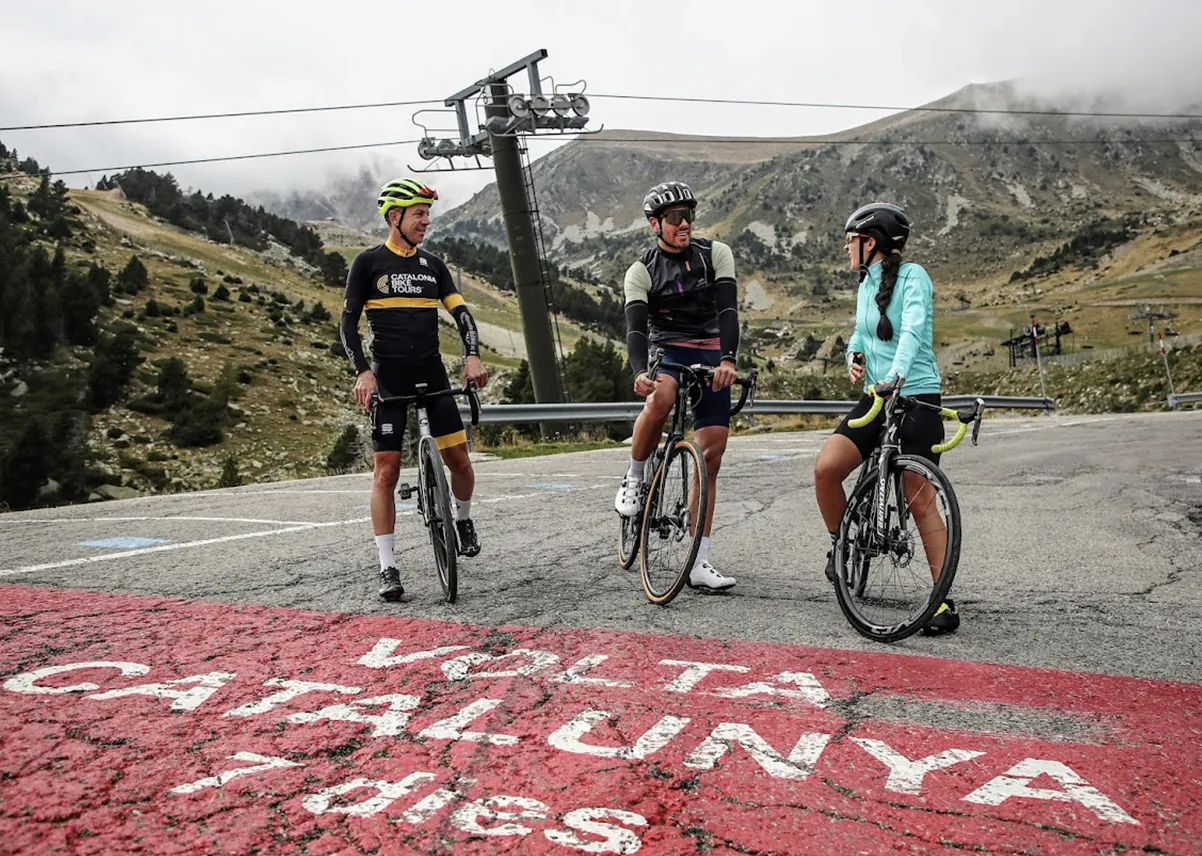
The climbs here also have a history. The Volta a Catalunya, one of the oldest stage races in the world, has crowned many of its champions on these roads, and La Vuelta has visited them too. Riding up Vallter 2000 or La Creueta, you’ll see the names of riders still painted on the road, and on any summer morning you may share the climb with professionals who live and train in Catalonia.
Another advantage is how varied the area is. In a single trip you can ride above 2,000 metres, cross into France, descend through beech and pine forests to medieval villages and finish your day with dinner in a town that has been there for a thousand years. And because the Catalan Pyrenees are so close to Barcelona, getting here is much easier than reaching the high cols of the Alps or the central Pyrenees.
Ripoll and the valleys of the Ripollès
The best base for riding the eastern Catalan Pyrenees is the Ripollès, a region of green valleys at the foot of the high mountains, crossed by the rivers Ter and Freser. Its capital, Ripoll, is often called the cradle of Catalonia. Its monastery of Santa Maria was founded in the 9th century by Count Guifré el Pilós, a key figure in the history of Catalonia, and its carved Romanesque portal is one of the great masterpieces of medieval art in Europe.
From Ripoll, the valleys lead in every direction towards the mountains. To the north-east, the Ter valley climbs through Sant Joan de les Abadesses, with another beautiful monastery, to Camprodon, a mountain town famous for its 12th-century stone bridge and its biscuits. Further up lie Molló and Setcases, the starting points of two of the best climbs in the area. To the north, the Freser valley leads towards Ribes de Freser and the high plateau of the Cerdanya.
It’s a land of stone villages, Romanesque churches and small family hotels, where life still follows the rhythm of the seasons. After a hard day in the mountains, there are few better places to rest.
Four climbs you won’t forget
These are the four climbs we would choose for anyone who wants to discover the eastern Catalan Pyrenees. Each one has its own character, from the steep hairpins of Vallter to the long, gentle road over the Collada de Toses.
Vallter 2000
12.2 km7.3% avg.
A classic of the Girona Pyrenees, and the hardest of the four. From Setcases, at the head of the Ter valley, the road climbs through forest and open meadows to the ski resort, with hairpin after hairpin in the final kilometres and the high peaks of the border all around you. It has hosted summit finishes of La Vuelta and the Volta a Catalunya, and the names of the riders are still painted on the road. At the top, the view down the valley is one of the best rewards in Catalan cycling.
Coll d’Ares
17.9 km3.4% avg.
The old border pass between Catalonia and France, above Molló. It’s a long, steady climb through meadows and forest, never too steep, with wide views back over the Camprodon valley. At the top, where the old customs post stood, the road drops into the Vallespir valley on the French side. It’s the perfect climb to settle into a rhythm and enjoy the mountains around you.
Coll de la Creueta
21.1 km5% avg.
The gateway to the high Pyrenees from the Berguedà, and one of the longest climbs in Catalonia. The road climbs past the village of Castellar de n’Hug, near the source of the river Llobregat, and on through high mountain pastures with views of the Cadí range. It has often been decisive in the Volta a Catalunya, and its length makes it a real test, but the gradient is steady enough to ride at your own pace.
Collada de Toses
21.5 km3.2% avg.
A long, gentle climb from the high plateau of the Cerdanya back towards the Ripollès valleys. The road is wide and well surfaced, and the gradient is never steep, so it’s a climb to settle into a rhythm and enjoy the views of the high peaks around you. From the top, at 1,790 metres, a long descent takes you back down towards Ribes de Freser and Ripoll.
Want to ride all four? Our Pyrenees tour takes you over all of them, with a shorter option every day. See what’s included →
A day in France: the Cerdanya
From the Ripollès, the road climbs to the Cerdanya, a wide, high valley at more than 1,000 metres of altitude, surrounded by peaks and shared between Spain and France. It’s one of the sunniest valleys in the Pyrenees, and riding here feels completely different: long, open roads, big skies and views of the mountains on every side.
The Cerdanya also has some surprises. Llívia, a small Spanish town, is completely surrounded by French territory, a curiosity left by a 17th-century treaty. On the French side, the fortified town of Mont-Louis, built by the military engineer Vauban, is a UNESCO World Heritage Site, and near Font-Romeu you can see the giant curved mirror of the Odeillo solar furnace, one of the largest in the world. Crossing the border, you notice how the language, the bakeries and even the road signs change in just a few kilometres. For many riders, a day in France is one of the highlights of a trip to the Pyrenees.
When to go: the best months to ride
The best months for the high passes are from May to October. In late spring the mountains are green, the days are long and there may still be snow on the highest peaks, which makes for spectacular views. September and October are often the best months of all, with stable weather, mild temperatures and fewer visitors.
July and August are good for the highest climbs, but the valleys can be warm, so it’s worth starting early. Summer in the mountains also brings afternoon thunderstorms, which can arrive quickly and with heavy rain. The best plan is to be on the road early and over the highest pass before the early afternoon.
In spring and autumn the lower climbs are perfect, but the highest roads can be cold at the top, even on sunny days. Whatever the month, pack a windproof jacket and warm gloves for the descents.
What you’ll eat in the Pyrenees
Mountain food is strong in flavour, hearty and perfect after a long day in the saddle. In the Ripollès, look for local lamb, game in autumn, mushrooms from the forests and the cured sausages of Camprodon. Nearby, La Garrotxa is known for its “volcanic cuisine”, based on local products such as potatoes, beans and buckwheat.
In the Cerdanya, two things are a must. The first is trinxat, a simple and delicious mix of cabbage, potato and bacon. The second is the valley’s traditional meat and cured sausages, made the same way for generations. Many villages have small restaurants serving traditional dishes at very reasonable prices, and a long lunch on a terrace with a view of the mountains is part of the experience. For the road, nothing beats a coffee and a piece of local cake in a village square.
Before you go: a few tips from us
- Gearing. Long climbs are much easier with a compact chainset and a wide cassette. Our rental road bikes are set up for the mountains.
- Layers. Even in summer it can be 10–15 °C cooler at the top than in the valley. A gilet, arm warmers and a windproof jacket make the descents much more pleasant.
- Start early. In summer, being on the road early helps you avoid the heat in the valleys and the afternoon thunderstorms in the mountains.
- Water and food. On some climbs there’s nowhere to refill for long stretches. Your GPS route shows where the fountains and cafés are.
- Getting there. Ripoll is around two hours from Barcelona by regional train or by road, and we can arrange a private transfer.
Ride these climbs with us
Pyrenees Self-Guided Road Bike Tour
Our Pyrenees tour brings together the best of these climbs in a route based around Ripoll, with comfortable hotels chosen for cyclists, luggage transfers, GPS routes and support from our local team every day.
3–5 stages97 km · +1,990 m a dayShorter option every dayStart: Ripoll
- Vallter 2000, Coll d’Ares, La Creueta and an optional day in the French Cerdanya
- High-end carbon road bikes or e-road bikes available to rent
From €1,350 per person
Keep reading
More from the cycling journal
Let’s start
Ready for the Pyrenees?
Tell us your dates and how you like to ride, and we’ll send you a proposal within 48 hours.
- Local team in Catalonia
- Support on the road, every day
- Rated 5.0 on Google